A Million-Panel Project
 NASAJuly 24, 20264 min read1 views
Earth Observatory Science Earth Observatory A Million-Panel Project Earth Earth Observatory Image of the Day EO Explorer Topics All Topics Atmosphere Land Heat & Radiation Life on Earth Human Dimensions Natural Events Oceans Remote Sensing Technology Snow & Ice Water More Content Collections Global Maps World of Change Articles Earth Matters Blog Blue Marble: Next Generation EO Kids Mission: Biomes About About Us Subscribe 🛜 RSS Contact Us Search June 16, 2024 June 6, 2026 A dry, tan-colored valley containing a few circular irrigated fields runs roughly north-south through the image. NASA Earth Observatory / Lauren Dauphin Grid-like arrays of solar panels cover parts of a valley floor in a brown, dry-looking area of Utah. NASA Earth Observatory / Lauren Dauphin June 16, 2024 June 6, 2026 A dry, tan-colored valley containing a few circular irrigated fields runs roughly north-south through the image.
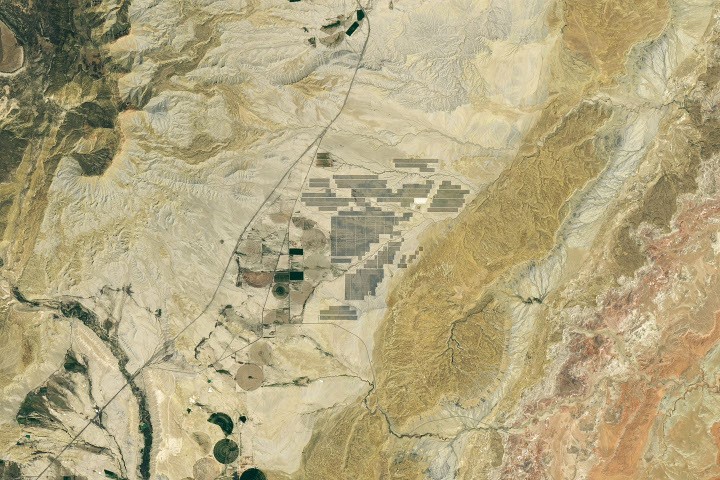
NASA Earth Observatory / Lauren Dauphin Grid-like arrays of solar panels cover parts of a valley floor in a brown, dry-looking area of Utah. NASA Earth Observatory / Lauren Dauphin June 16, 2024 June 6, 2026 Curtain Toggle 2-Up Image Details The nearly one million photovoltaic panels of a solar energy and battery storage facility in Utah appear in the right image, acquired with the OLI (Operational Land Imager) on Landsat 8 on June 6, 2026. The same sensor captured the left image on June 16, 2024.
NASA Earth Observatory images by Lauren Dauphin. Historically, central Utah’s Castle Valley has been a coal hub, with mining operations on the slopes of the Wasatch Plateau to the west active since the late 1800s. A different energy development arrived in the region in June 2026, when a large solar power and battery storage plant came online in the sunny valley about 130 miles (210 kilometers) southeast of Salt Lake City.
The recently constructed Green River Energy Center, seen in the Landsat 8 image above (right), features nearly one million solar panels and roughly 500 batteries on several square miles of previously undeveloped land. The facility has 400 megawatts of solar-generating capacity with another 400 megawatts of battery storage. S.
Energy Information Administration expects to be plugged into the country’s grid in 2026. The Utah facility is slated to supply power to Salt Lake City and other areas across the state, according to news reports , and project staff estimate it could produce enough electricity for more than 100,000 homes. With its integrated battery storage, the plant has the potential to generate power at all hours, even when the Sun isn’t shining.
And the Green River Energy Center can build on Castle Valley’s energy legacy by utilizing existing transmission lines originally built for coal-fired power plants in the area. Though Utah adopted coal as its state rock and has long relied on it for energy, other sources, such as solar and geothermal, are becoming larger parts of the state’s energy mix. In 2025, coal fueled about half of the state’s electricity generation , down from about 75 percent in 2015.
NASA
nasa.gov