Inference as Stereotype

Hacker News
July 20, 202610 min read
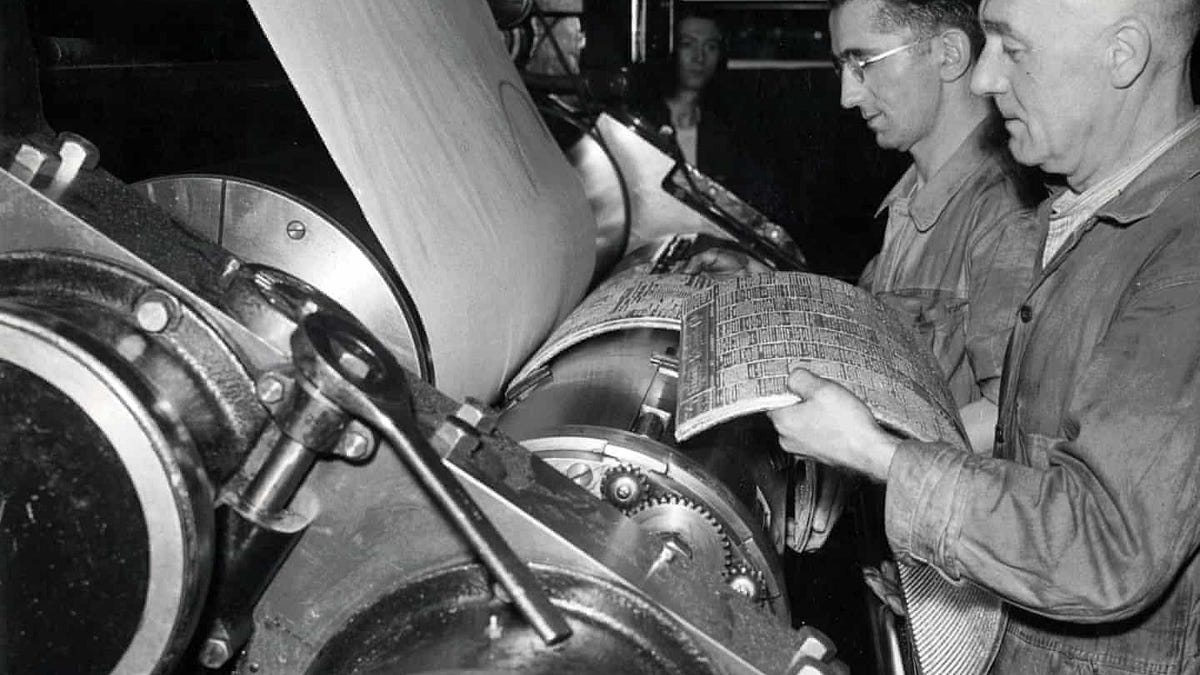
Hollis Robbins Jul 20, 2026 13 1 2 Share Before it was a problem, a stereotype was a solution. How do you print a piece of work at scale? The answer was to cast a solid metal plate from a page of set movable type, called a stereotype , first invented in 1725 but not commercially viable until around 1800. A print compositor would set the type, then take a plaster mold, then pour molten type-metal to make one rigid plate of the whole page. The original type was taken apart and put back into the letter case to set the next page. The first stereotyped book printed in America was a Bible, in 1812 , from plates the Philadelphia Bible Society imported from England. The American Bible Society, founded 1816 , made stereotypes its business model. By the 1820s half of American-made Bibles were stereotyped.
A stereotype makes sense with stable works (like the Bible), where you’re not likely to change a single word, and you are expecting a big print run. You can sell the print run and you can also rent or sell the plates to other printers and publishers, who can re-use them, but can’t change a word. This matters for my field (literature) because publishers decide early what to stereotype (like Uncle Tom’s Cabin ) and what not to (books you’ve never heard of). Famously, Ticknor & Fields, the publishers of The Scarlet Letter (1850), did not expect it to sell quickly and did not stereotype the first run. They scrambled and set an error-filled second run, and then finally cast stereotype plates for a third edition .
Anecdotal Value is a reader-supported publication. To receive new posts and support my work, consider becoming a subscriber.
Once you make a plate it isn’t useful for anything else except printing that page of text with ink and a fresh piece of paper. Newspapers, which cast fresh plates daily, melted them down at the end of the day (unless it was an important day). Book authors sometimes asked for their plates when a publisher was done printing (and the book wasn’t going to be a runaway best seller).
Today you read headlines about hundreds of billions of dollars being spent a year on inference chips , processors that do one thing, usually running a trained large language model (LLM). Google is reportedly developing a chip, nicely called Frozen v2 , that would permanently etch Gemini’s computing logic onto the silicon wafer, “akin to ‘freezing’ the software in the chip.” Is it a leap to compare an inference chip to a stereotype? No, in fact. The inference chip holds the finished model as a mass of frozen numbers, called weights.
AI models read and write in “tokens,” which follow similar principles to a type case, which was weighted toward which letters are most commonly used. A type case holds far more e’s than z’s, more vowels than consonants. You need letters in the proportions they appear. When movable type was set by hand, the most common letters were close at hand. Frequent pairs and words came pre-cast as single pieces — fi, fl, and the “&.” A token set is built the same way: a large corpus is scanned, the character sequences that appear together most often are merged into single units, common whole words become one token (like “and” was one sort), and rare words are assembled from smaller pieces. The model then generates one token at a time, predicting each from the likelihood of what follows what.
An LLM is one enormous formula for predicting the next token , and the weights are its settings: hundreds of billions of numbers whose values, in combination, determine what the model writes. A model is trained by scanning a corpus that includes just about everything written often enough to survive, which is why so many stereotyped texts are represented in the corpus.
Training adjusts the model’s prediction toward what texts in the corpus tend to say. When training stops, the weights are fixed, somewhat similar to the way a page of type is fixed before the molten metal is poured to make a stereotype. The model reads the fixed numbers from memory and uses them to process a response to a prompt, without a mechanism to change a weight. With a stereotype, every fresh sheet rolled against it looks the same. With an LLM, the answers vary with the prompt, but the same assumptions (weights) are operating. Everyone will get a similar answer to a similar question.
Some differences. First, the weights are a file, and a file can be copied exactly and endlessly, so millions of users can use it. Second, in this analogy the weights are the stereotype plate and the chip is the press. When a company retrains its model, it’s a new stereotype plate. Neither the stereotype plate nor the chip is “corrected” by editing at the margins. The Bible Society’s “ Directions for Repairing Plates ” describes physically working the metal, like an auto shop getting rid of a dent. If there is an error in a trained LLM, whole new weights are produced.
In printing, the expensive part is setting the type for the first plate. After that, each copy costs only ink, paper, and press time. There is the cost of the metal to make the stereotype plate and the craft of making the plate, but once that is done it is cheap to strike from it. Selling print copies from a stereotype plate is a stable revenue stream.
A data center is a factory that manufactures tokens, as Jensen Huang put it. Each token, he says, is a unit of profit, and he predicts high-end tokens will sell for up to $1,000 per million. The factories run two main chip designs: NVIDIA GPUs and Google TPUs, which keep the weights in high-bandwidth memory stacked next to the processor and stream them in; and Groq’s LPU, which holds the weights in SRAM spread across the die and uses no HBM. Groq states its SRAM is about 100 times faster than the HBM that GPUs use. Groq sells the output as “ Tokens-as-a-Service ,” billed per token.
The business decision to invest in upfront costs and then sell copies is the business decision to invest in inference. Training a frontier model (the ones you see in the news with the most cutting-edge ability) is the expensive part involving labor, thousands of specialized chips, hundreds of millions of dollars for the largest models. Once a model is trained, the output is cheap. You pay for each answer, at a rate per million. The model reads your input in tokens and writes its answer in tokens. You pay for both. The AI industry calculates tokens per second and tokens per watt.
Given the upfront costs, only producers with enough capital to buy a press and a set of movable type, and with a paying readership lined up, could go into the stereotype business. Frontier-model training is limited to a few firms, like OpenAI, Anthropic, and Google, that could bear costs before inference revenue. The model stays on their servers, your question travels to their data center through an account (called an API, an arrangement for sending work to someone else’s machine and getting the result back), their copy of the model answers on their chips, and you are billed for the tokens. You never touch the model.
The second way to make money is to hand out the stereotype plate to anyone who wants it. For years Meta gave away the weights of its Llama models: anyone could download the file of numbers and print from it on their own hardware, paying Meta nothing per copy. Meta has since gone closed . The Chinese company DeepSeek still gives its models away, and its January 2025 release matched the expensive American ones. These are called open-weight models. The downloader basically gets the stereotype plate without the manuscript: the weights are public but the training data, the reasoning why it works as it does, stays private. In the open weight paradigm the user can “melt it down and recast it” or in this case, train it further on new texts to produce new weights.
Why give away a stereotype plate that cost a fortune? Because the business model undercuts everyone selling impressions. In the print news era, syndicates mailed ready-made stereotype plates of articles and filler to small-town papers, which printed them as their own. This is the origin of the word “boilerplate.” Handing out plates spreads the output without spreading the ability to set a page, which would be competition. Training stays where the capital is.
Type case, type case, Dallas Morning News November 23, 1963, Google TPU Chip My point in making this analogy (of course there are differences) is to reach people in the higher education sector who aren’t really thinking about AI in the right way. Higher ed is already tying itself in knots arguing about political polarization and anthropology and “character formation” and the despair of learning outcomes and whether anyone learns anything in college and why go. My view is that in the AI era, universities should be sites that focus more on frontier knowledge and unknowns (as I’ve written about re: the Rumsfeld Matrix ). Teaching “ known knowns ,” which is what general education is, is less and less important in the AI era.
Both stereotypes and inference chips are an investment in stable knowledge and known knowns. An investment in inference assumes stable recorded knowledge. This is good, for many reasons. Stereotype plates put a Bible in every household. Inference puts competent answers within anyone’s reach for a fraction of a cent.
Frontier knowledge, outside the stable, fixed knowledge, remains expensive. Universities, I have been arguing, should be where new questions are asked and new knowledge is made. You hear the frontier AI model laboratories claiming their newest models are beginning to produce results that were in no corpus (an OpenAI model disproved a 1946 Erdős conjecture this spring and just yesterday Fable disproved the Jacobian conjecture). But their capital is amortized against serving answers at volume, which are overwhelmingly known knowns. The business case is still stereotype plates.
Remember textbooks? They were a stereotype plate business model which is why if you got two of the biggest states (Texas and California) to sign off on something you could make books that you could print by the hundreds of thousands if not millions. Now the token does it cheaper.
The four largest technology companies plan roughly $725 billion in capital spending for 2026, most of it on inference. The financing has raised eyebrows. The companies depreciate the hardware over five or six years while the life of the chips is probably two or three. Everybody’s funding each other: Microsoft invests in OpenAI, OpenAI spends the money on Azure, and that spending justifies Microsoft’s next round of capital. Demand looks independent but it isn’t. And the market has rehearsed a correction once already: in January 2025, when DeepSeek’s free plates matched the expensive ones, Nvidia lost roughly $590 billion of market value in a single day, the largest one-day loss any company had recorded.
As the price per token continues to fall (and it will fall, since anyone can create a free cast at the cost of electricity; Dean Ball makes the same point from the policy side) print runs must keep lengthening for the stereotype to pay. The business case requires canonical, stable works like the Bible. The UK’s AI Security Institute measures open-weight models trailing the newest proprietary models by four to seven months on its cybersecurity evaluations, down from six to ten months a year ago.
Will consumers just keep wanting consensus, known known “answers” from chatbots? I hear complaints already about sameness and people coming to the same ideas at the same time. A paper in Trends in Cognitive Sciences this March argues that when different users’ expression runs through the same models, their distinct styles, perspectives, and reasoning strategies become homogenized. A study of 6,875 student essays found that quality improved with AI assistance while structural diversity collapsed, the essays losing 70 to 78 percent of the variance in how they wer
Read what's here, then head to the original whenever you're ready - never required.
Continue Reading on Hacker News