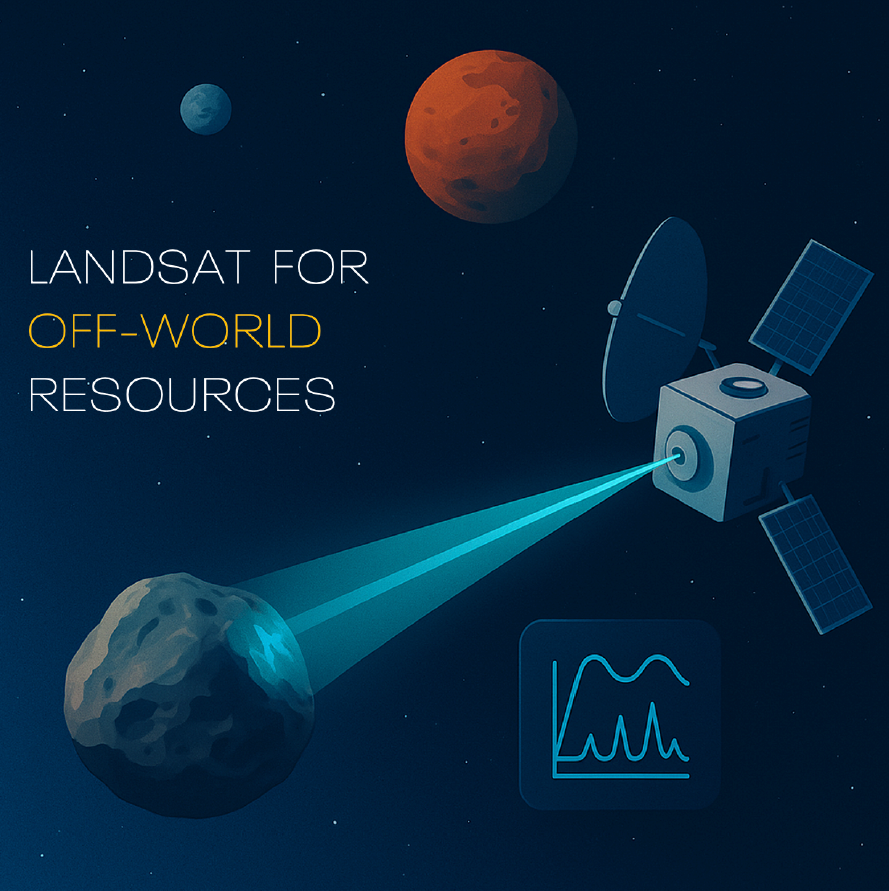
Interworld Slingshot Resource Surveys
 NASAJuly 21, 20262 min read
3 min read Preparations for Next Moonwalk Simulations Underway (and Underwater) Graphic depiction of the Interworld Slingshot Resource Surveys concept. Pablo Sobron Pablo Sobron Sanchez SETI Institute This proposal explores a new class of reconnaissance spacecraft that map minerals from orbit using Raman spectroscopy during high-speed flybys–without landing, sample return, or extended dwell. If feasible, this concept would enable NASA to evaluate ice and ilmenite at the Moon, ore content at asteroids, and volatile-bearing minerals at Mars’ moons–all with a single 300-kg spacecraft.
The central objective is to determine whether Raman spectroscopy–a technique that identifies minerals by their molecular fingerprints–can operate from tens of kilometers away during flyby or orbital arcs. To date, planetary Raman has only been used from meters away on rovers. At each leg, a high-energy pulsed laser, time-gated photon-counting detector, and rad-class beam steering system isolate Raman signals from the planetary surface.
To determine feasibility, this NIAC Phase I study answers three core questions: (1) Can key mineral Raman lines be detected with adequate signal-to-noise from 50 km? (2) Can beam pointing and smear be stabilized during fast flybys to allow integration over dwell time? Methods include first-principles photon modeling based on known Raman cross-sections, spacecraft jitter analysis, and trajectory design using NASA’s standard mission planning tools.
The study is divided into three technical work packages plus synthesis and reporting. Sensitivity analyses and decision gates are built in to determine how changes in photon return or pointing control would affect overall mission viability. Alternative architectures are explored for each leg, including lower flyby altitudes and different propulsion schemes.
The study team combines deep expertise in Raman instrumentation, spaceborne lidar, and mission design. PI Sobron led field 120-meter-range Raman systems and contributed to SuperCam and SHERLOC on Mars. Co-I Lee and Collaborator Yu from NASA Goddard bring direct heritage from ICESat-2 and other orbital laser systems.
Co-I Casell at NASA Ames leads early mission design and brings prior NIAC experience. If successful, the work will define the first architecture for orbital Raman mineral detection and demonstrate that high-resolution molecular mapping is possible without landing. Even partial success would establish new boundaries for remote sensing physics, provide validated models, and support future NASA decisions in Artemis siting, asteroid mining, and Mars ISRU planning.
The architecture enables a cost-effective Discovery-class template that could eventually scale to a fleet of inner Solar System scouts–bringing Landsat-style mineral intelligence to planetary exploration.
NASA
nasa.gov