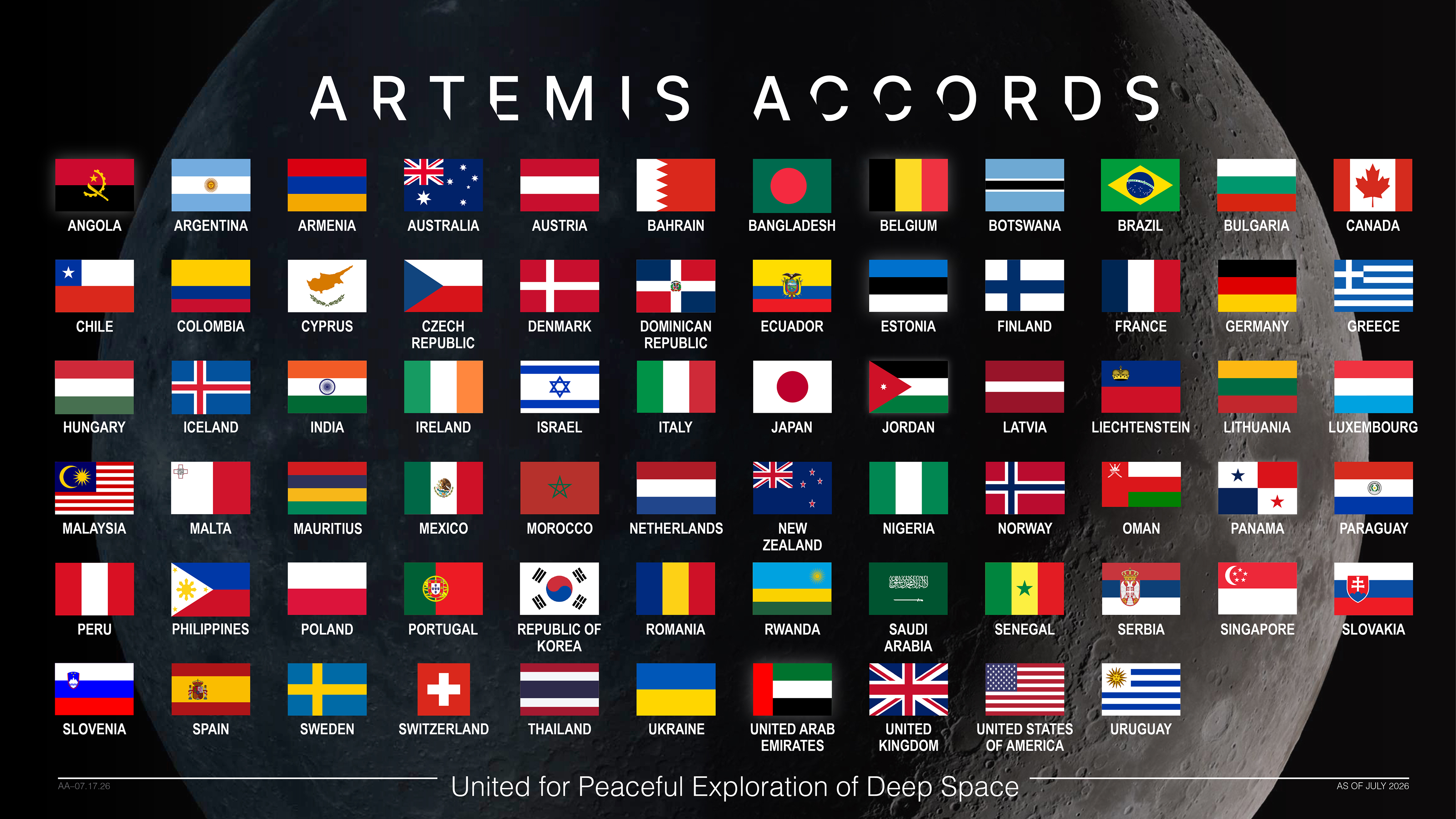
NASA Welcomes Mauritius as 70th Artemis Accords Signatory

NASA
July 17, 20262 min read
Credit: NASA The Republic of Mauritius has officially joined the global coalition committed to responsible space exploration, becoming the newest signatory and seventh African country to join the Artemis Accords. NASA’s Deputy Administrator Matt Anderson contributed video remarks for a signing ceremony on Friday, in the island nation’s city of Ébène. “Together, we are creating the foundation for future exploration while ensuring that space remains peaceful, accessible, and beneficial for all.
America will return to the Moon and ignite the Golden Age of exploration and discovery. ” Mauritius’ Permanent Secretary at the Ministry of Tertiary Education, Science and Research Navindsing Jugmohunsing signed the Artemis Accords on behalf of the country. S.
S. Chargé d’Affaires to Mauritius Craig Halbmaier were present to witness the signing. “The accession of Mauritius to the Artemis Accords marks a defining chapter in our New Space journey,” said Jugmohunsing.
“As a Small Island Developing State in the Indian Ocean, we are committed to ensuring that space serves humanity by protecting our oceans and coastlines and amplifying the voices of nations like ours. ” NASA first engaged with Mauritius through its early global mapping efforts, owing to the nation’s strategic location. Between 1965 and 1980, NASA used several satellite missions to collect global measurements of Earth’s size and shape.
As part of that work, NASA sent teams to Mauritius and other international tracking stations that supported satellite photography for geodetic analysis. Their observations strengthened the navigation technologies used from Apollo to Artemis and helped lay the foundation for the partnership reaffirmed today by the Artemis Accords. In 2020, NASA and the Department of State joined with seven other founding nations to establish the Artemis Accords, responding to the growing interest in lunar activities by both governments and private companies.
They introduced the first set of practical principles aimed at enhancing the safety and coordination between like-minded nations as they explore the Moon, Mars, and beyond, committing nations to: explore peaceably and transparently render aid to those in need enable access to scientific data ensure activities do not interfere with those of others preserve historically significant sites and artifacts by developing best practices Five years later, President Donald J. Trump’s National Space Policy directed NASA to establish a sustained lunar outpost.
Read what's here, then head to the original whenever you're ready - never required.
Continue Reading on NASA