Perplexity Pro limits: the shrinking $20 plan, in 1,024 posts

Hacker News
July 21, 20267 min read
Akira Sumi · Jul 19, 2026 · 9 min read · researched
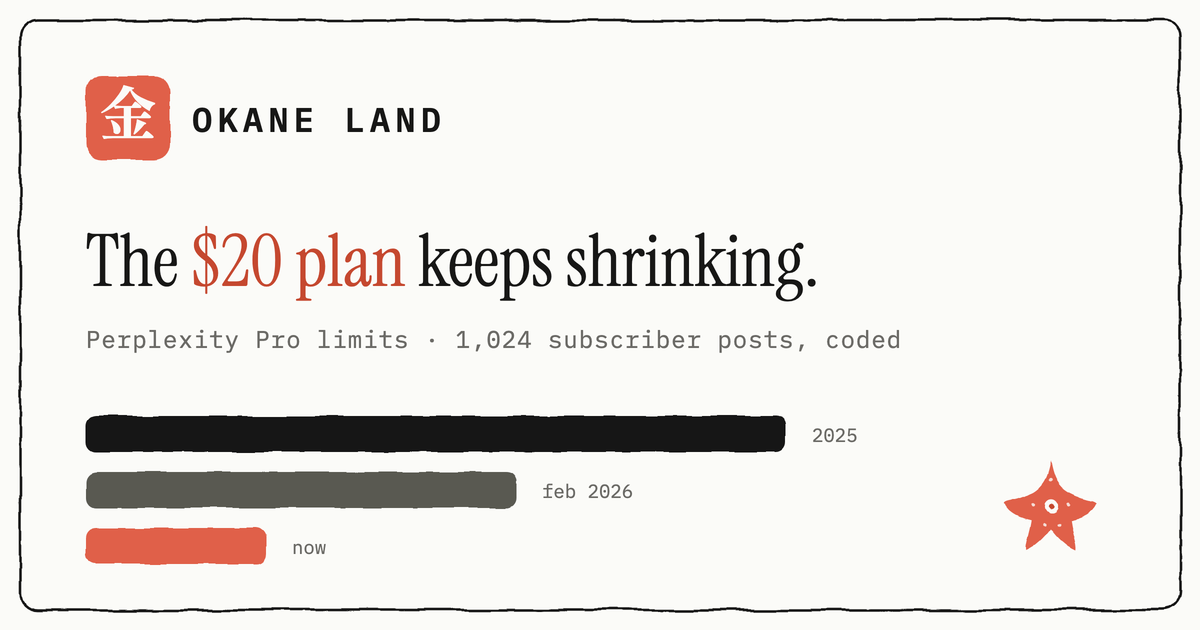
In February 2026, Perplexity announced an upgrade to Deep Research, and the replies under the announcement did the arithmetic the post left out: the Pro allowance had moved from hundreds of runs a day to about twenty a month . It was the second time in four months that paying subscribers found out about a cut by hitting it. It was not the last. If you pay Perplexity anything, Pro is still the tier to buy, and every limit you read, including the ones on their own pricing page, should be treated as provisional until you see it hold in your account.
That is the sharpened version of the verdict from our hands-on Max review , and this piece is the evidence behind the sharpening. We collected and coded 1,024 posts from Perplexity’s paying subscribers, across the subreddit, the official forum, Hacker News, the App Store, and Trustpilot, to answer the question a review of a moving product cannot: what happens to the tier after the reviewer leaves. The search data says people are asking. Worldwide interest in “cancel perplexity” hit its 12-month peak this month, and “perplexity pro limits” runs neck and neck with it.
Everything below is the evidence, with the caveats attached where they belong.
The dataset is 1,024 posts from the past year: 359 from 19 hand-read threads on r/perplexity_ai, 101 from the official community forum, 394 from Hacker News, 150 recent App Store reviews, and the first page of Trustpilot. Each post was coded for topic, stated tier, and whether the author was keeping, cancelling, or deciding. The counts come from keyword matching with a hand-checked pass on top, so they undercount anything people describe in their own words, and every one of these channels is self-selected. Nobody posts “my subscription worked today.” What the corpus is good for is ranking what paying users bring up on their own, and quoting them verbatim. That is how we use it. The full annotation file, one coded row per post with its permalink, is published as an open dataset so you can check the coding yourself.
One population note matters more than the rest: a very large cohort got Pro free for a year through PayPal, Venmo, Revolut, and carrier promotions, and those accounts were reportedly throttled hardest. Some of the anger in these threads is promo users meeting the real price of what they were given. Some of it is from people who paid cash and watched the product change under them mid-contract. We flag which is which where the poster says so.
November 2025, the routing scandal. The year’s top thread on r/perplexity_ai, at 1,242 points, showed Claude-labeled answers being served by cheaper models , verified by an open-source browser extension that watched the network traffic. The CEO responded in person: “this was an engineering bug, and we wouldn’t have found it without this thread.” The top reply, at 311 points, kept the receipts in frame: “The quality genuinely dropped… even when the UI claimed it was” the selected model. Whatever the cause, the episode taught the community to verify the label, and a chunk of it never went back to trusting the picker.
February 2026, Deep Research. The upgrade announcement doubled as a quota change. A separate thread titled “99.89% Reduction in Research quota over night without any formal communication” put numbers on it: roughly 600 runs a day before, about 20 a month after. One annual subscriber posted the pricing page still advertising unlimited research next to his empty meter and started a chargeback.
May 2026, Pro searches. Subscribers found the weekly allowance cut from 200 to 100 , visible in the account API as a remaining-quota field, with no notice. The detail that filled the thread was contractual: it applied mid-term to prepaid annual plans . One self-paying subscriber, distancing himself from the promo cohort: “I paid the full price for a year with my own money.”
By July 2026 the threads stopped being about any single cut. “What Happened to Perplexity?” is 432 points of former daily users comparing exit dates, and a 13-month Pro subscriber cancelled the week we gathered : “the platform has gone downhill so fast recently that I just can’t justify the price tag anymore.”
Keyword counts undercount, and the routing number is the proof: 34 coded posts, sitting under three threads totaling more than 2,200 points and 500 comments. Volume of feeling and volume of keyword are different things. The Computer agent credit cluster is worth a line of its own, because it is the newest complaint shape: the agent is genuinely capable, and it meters through credits at a pace users describe with the word “burned.” One Max subscriber: “70k credits burned in 2 months.” One Pro user who topped up: “I just bought 1500 credits and it burned through them so quickly.”
Our review’s verdict was that $200 Max is for a narrow heavy-use case. The community’s Max defenders, read closely, agree. The most committed one titled his thread “Pro plan is a SCAM, Max plan ($200) is worth every penny” and claims Max saves him ten hours a week. Under questioning he concedes that web search is “Not the primary for sure” of his usage, and that for searches he picks the default model anyway. His whole case is the agent running tasks in parallel while he works. The thread sits at zero points, and its top reply is the median subscriber’s answer: “most people aren’t using or gaining from it enough to justify shelling out $200 a month.”
The other named defenders match the profile: one calls Opus through Max with MCP connectors “worth it in max alone,” another switched for heavy Research and Labs throughput. All of them describe the workload our review carved out. Meanwhile Max has its own complaint file: a Trustpilot reviewer paying $200 a month calling the results “the worse by far” of the AIs he pays for, a Max user who left because he “used to hit my limit on perplexity all the time and have to buy credits,” and forum reports that quota complaints now come from Max accounts too. Upgrading to escape the limits is buying a higher ceiling in the same weather.
Zoom out and the product looks loved. Google Play: 4.6 stars, 2.03M ratings, an Editors’ Choice badge. Zoom into the channels where paying customers file grievances and it looks radioactive. Trustpilot: 1.5 out of 5 across 707 reviews, 82% one-star, nearly all of them billing and refund disputes. Our 150-review App Store slice splits the same way: 85 five-star reviews praising the answers, 44 one-star reviews about charges and walls.
Both mirrors are accurate for the door they stand behind. The broad, mostly free user base likes the app. The people who gave Perplexity money and hit a limit, a charge, or a support queue are the unhappy ones, and they are the population this piece is about, which is exactly why we would not quote our own numbers as “most users.” Self-selection cuts both ways, and any review, ours included, that ignores one mirror is selling you the other.
The pricing page, as we captured it in July 2026 , lists Pro at $17 a month billed annually with “usage limits for everyday use,” no numbers attached, and reserves the word “unlimited” for the $167-a-month Max tier. The current limits live in your account, and they have a documented habit of moving. So:
The pattern we coded is not unique to one company: every AI subscription reprices as inference costs meet investor math . What the 1,024 posts add is the subscriber’s-eye view of what that repricing feels like, and the defense against it. Pay monthly, count what you get, and let your own meter tell you what the plan is.
One email, when there's something worth sending
No fixed schedule, no filler. You get an email when we've tested something, run the numbers, or found a tool worth your time.
Free. Double opt-in, unsubscribe in one click.
Paying for AI search yourself? Compare notes in the forum ↗
Read what's here, then head to the original whenever you're ready - never required.
Continue Reading on Hacker News