The Night France Saved the British Grid

Hacker News
July 21, 202610 min read
Ben Jul 20, 2026 ∙ Paid 14 5 Share For forty-eight minutes on the evening of Monday 23 June — a 33°C midsummer Monday — the frequency of Great Britain's electricity grid sat below 49.8 Hz, the boundary of normal operation. At 17 seconds past eight o'clock it touched 49.657 Hz, its lowest point of the year — though, as I wrote in the immediate aftermath , it stayed clear of the statutory floor at 49.5: this was never a blackout in waiting, and this article will not pretend otherwise.
Nothing switched off. No public warning was ever issued. And almost nobody noticed that, for 48 minutes, Britain's electricity system was running on a draining battery fleet, a gas margin of roughly eighty megawatts, and — finally — an unpriced phone call to Paris.
I've spent the last month reconstructing that evening minute by minute, from both sides of the Channel: Elexon settlement data down to individual generating units, NESO's one-second frequency record, the system operator's own trading books, and — via RTE's APIs — the French grid's answering records. Along the way I have also had the benefit of conversations with people who watched the evening from the other side of it — traders and market folk in several European markets, who saw the British grid's difficulties arrive on their own screens, and who cannot be named. Their fingerprints are on this piece in ways I won't itemise. That access shaped a deliberate choice: the mainstream telling of 23 June is relentlessly British — British data, British institutions, British questions. But half of this story happened in other countries' control rooms and other countries' order books, and I have tried to tell it from their side of the water too: as our neighbours and partners saw it, not merely as we did. What follows is the anatomy of a near-miss that the official record describes, accurately but incompletely, as a day when "the grid kept working."
It did. In the same sense that a driver who runs a red light and isn't hit keeps driving.
Act I — A grid already two-fifths gone The story of 23 June begins weeks earlier, in maintenance calendars.
By the morning of the 23rd, 21.2 gigawatts of British generating capacity was on outage — 12.6 GW planned, 8.6 GW unplanned. Half of Dinorwig, Britain's biggest pumped-storage station, was away on nine-month overhauls. All four units at Cruachan sat at zero. Connah's Quay-2 had failed the previous day. And Sizewell B — the only nuclear station in the south of England — was entirely absent, both units on statutory outage since May: 1.2 GW missing from precisely the half of the country where the evening's shortage would land. And on top of the outages sat another 2.6 GW of standing partial derates — big CCGTs registered at one output and physically capable of less.
The cables to Europe were wounded too. IFA, the original French interconnector, had been running on one-and-a-half poles since a DC cable fault in March. Greenlink to Ireland was out entirely. And ElecLink — the interconnector through the Channel Tunnel — had a quieter handicap: planned 400 kV works in the Calais corridor had zeroed its export direction for the summer, leaving it a one-way street toward Britain. That morning the one-way street worked fine. By mid-afternoon it would become the day's strangest mystery.
One more thing the control room knew that morning, and it matters later: conditions on the other side of the Channel were tough too. France was fighting the same heatwave with a large slice of its nuclear fleet unavailable and river-cooled reactors carrying warm-water derates. Not a crisis over there — but not a neighbour with power to burn, either.
Against this backdrop, the day-ahead auctions did something that would define the evening: they scheduled Britain to export electricity to the continent, all evening, with the evening peak priced at £250/MWh. High — two to three times a normal June evening — but comfortable. The market saw strain. It did not see what was coming.
Here is the first myth of 23 June: that too much solar power broke the grid.
The opposite is true. Midday — maximum sunshine — was the easiest part of the day. Solar delivered 15.2 GW, slightly more than forecast, and Britain had so much power that the system operator's problem was surplus: NESO spent the morning selling electricity at £76/MWh and managing low inertia, the classic headache of a renewables-rich grid at noon. The sun then set on schedule, exactly as predicted. Solar was the best-behaved actor on the entire system.
There was a second gift from the sun that morning, and it came through the cables. At midday Britain was importing around 5 gigawatts from the continent — much of it Europe's own solar surplus washing across the Channel at prices that made burning gas pointless. And here is the trap hidden inside that comfort: sunset is synchronised across Europe. As Britain's panels faded, so did France's, Belgium's and Holland's — and the same cables that had delivered 5 GW at lunchtime swung to exporting 3 GW by 19:00, an eight-gigawatt reversal in seven hours , right into Britain's evening ramp. France's own export cushion touched zero at 19:00 BST, the exact hour Britain's crisis began. Interconnectors are sold as diversification; against a continental sunset, they are correlation.
The morning's real story went unnoticed. At 10:00 and 10:40, two units at Pembroke — Britain's flagship gas station — failed forty minutes apart. Eight hundred and ten megawatts, gone. In a grid drowning in solar, the loss was absorbed invisibly and the market barely blinked. The lesson, which the evening would teach brutally: the size of a failure matters far less than its timing.
At 13:00, ElecLink stopped. Not commercially — the intraday book had it importing at its full 1,014 MW through the afternoon and into the evening. Not officially — its published import capability read No Restriction , 1,014 MW, in every declaration NESO carries. The metered flow simply fell off a cliff: 848 MW at half past twelve, 36 at one o'clock, then zero — and it stayed at zero for the next seven hours, through the entire build-up you are about to read. Nearly five gigawatt-hours of bought-and-scheduled French imports, physically absent, with no fault notice, no capability restriction, and no outage record on either side of the Channel to account for it . I call those the phantom seven hours, and you can only find them by holding the schedule book against the metering.
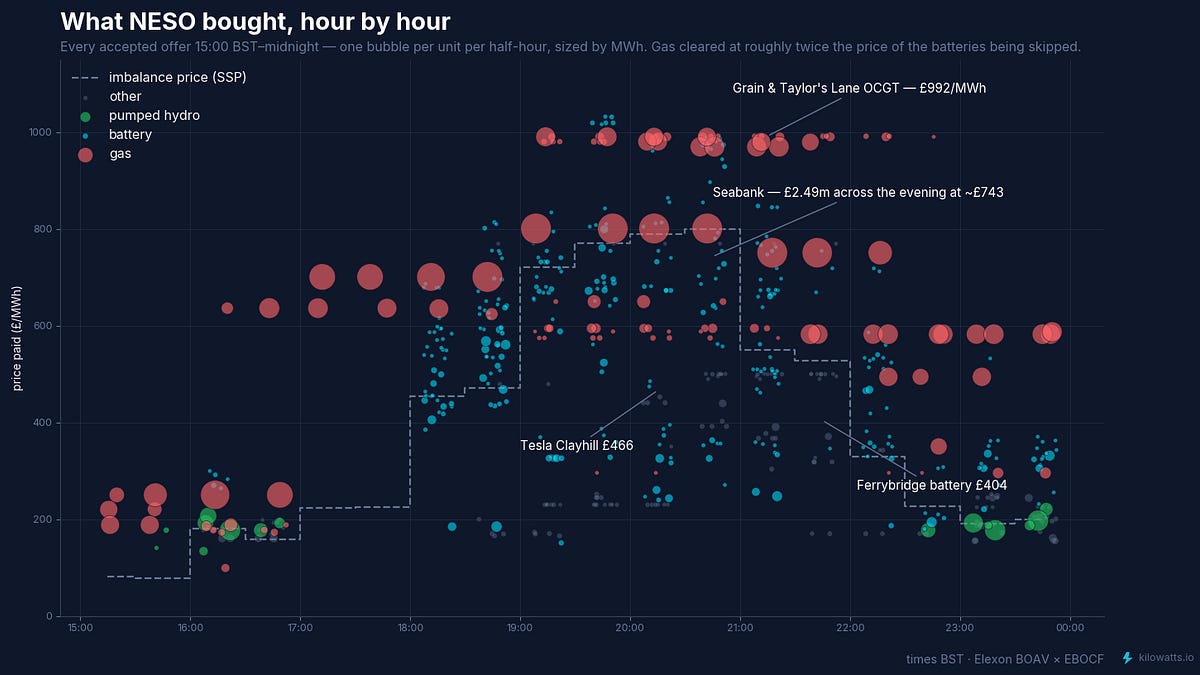
At 14:18 — seventy-eight minutes after a gigawatt of imports vanished from the wires — something remarkable happened in NESO's trading room: the operator bought its entire evening safety margin in a single burst — 111 forward trades, 5,700 MWh, executed within minutes of each other, at prices rising to £876/MWh . Three and a half times the day-ahead price. Hours before the event. Priced, it would turn out, almost exactly at what the evening settled at.
The control room, in other words, saw the nightmare coming at lunchtime — including, evidently, things the public data did not show — and quietly paid up for insurance. What it did not do was tell anyone. No Electricity Margin Notice was issued — not then, not ever that day. The market's last public forecast of the evening remained £250.
The gap between what the public market believed and what the system actually cost is the single most eloquent chart of the day. The same evening megawatt-hour carried three different prices depending on when you asked: £250 in the day-ahead auction, £561 in the intraday market as traders caught up through the afternoon, £800 at final settlement — and £1,032 for the marginal action at the peak. Each price was a snapshot of how much of the truth had leaked out.
And from mid-afternoon, every layer of the system thinned at once:
The heat shaved 2,247 MW off the operating gas fleet — 12.7% — and, counterintuitively, it cut deepest on the newest, most efficient machines. Keadby 2, Britain's most efficient CCGT, lost 10.6%. Pembroke's surviving units lost 13–16%. The 1990s veterans barely moved: their age had already been priced into their ratings years ago.
Wind ran 1.7 GW below a forecast that was — astonishingly — still rising . NESO's own updates pushed the evening wind forecast up to 7.1 GW during the day; the turbines delivered about 5. The most accurate forecast NESO ever had was the one published two days early.
Across the solar shires — Cornwall to East Anglia — 32 substations flipped, one by one between 15:00 and 18:00, from feeding the grid to drawing on it, handing nearly 7 GW of demand back to the transmission system as rooftop solar died with the light.
And at each hour boundary, the auction-scheduled export ramps hit the grid like hammer blows: at 18:00, four interconnectors swung 1,109 MW of exports on in five minutes, and frequency dropped an eighth of a hertz on the spot.
Sheffield Solar's PV_Live data lets you see the third of those bullets properly, and it deserves to be seen, because it demolishes the lazy reading of the evening. Between four and nine o'clock, the demand on NESO's screens climbed six gigawatts — which sounds like a nation coming home and switching on. It was the opposite. Add the solar back and underlying consumption actually fell five gigawatts across those hours — Britain was winding down for the evening. What climbed was not demand but visibility : eleven gigawatts of rooftop generation went down with the sun, and five hours of hidden consumption walked back onto the transmission grid to be served the old-fashioned way. The grid's hardest ramp of the year happened while the country was switching things off.
By early evening, the deliverable gas headroom south of Britain's congested transmission boundaries had collapsed from 8 GW at lunchtime toward a few hundred megawatts — a 40-to-1 collapse in seven hours.
The wind story deserves its own picture, because it is genuinely strange. Forecasts are supposed to converge on the truth as the horizon shortens. On 23 June they did the opposite: the two-day-ahead forecast was the most accurate NESO ever had, and every subsequent revision moved away from what the turbines would actually do — the on-the-day updates climbing to 7.1 GW, even 8 GW, while the fleet delivered five. Whatever the models saw building in the evening weather, the wind never showed up to match it.
Was the miss extraordinary? No — and that's the frightening part. Ranked against every day of 2026 so far, 23 June's wind forecast error was the 80th largest out of 198. A one-and-a-half-to-two-gigawatt evening miss happens roughly two days in five. Britain routinely runs forecast errors larger than its entire formal reserve standard — the SQSS requires securing 1,320 MW — and normally gets away with it because incidental headroom absorbs the difference. On 23 June, the incidental headroom was gone. The error was ordinary. The margin was not.
And wind was only half the forecasting story, because demand was misbehaving in the same direction. The day-ahead demand forecast ran about 800 MW under the actual evening, and at the worst half-hour of the ramp the miss reached 1,446 MW — another Cottam-and-a-half of shortfall, invisible until teatime; only the 16:48 revision, published as the squeeze was already on, finally caught the shape of the evening.
But the deeper problem with the demand forecast is not its error. It is its geography — it has none. The forecast NESO publishes, trades against, and calibrates is national : one number for an island whose crisis that evening was entirely about where the demand sat relative to full wires. A national figure can be nearly right and operationally useless at the same time — and on the 23rd it was: nearly right nationally, while the south east starved behind constraints the forecast cannot see. Nor can an outsider check the geography after the fact: I tried to reconcile NESO's day-ahead zonal demand forecast against the settled per-substati
Read what's here, then head to the original whenever you're ready - never required.
Continue Reading on Hacker News