Science
 BBCAugust 4, 20267 min read1 views
Image source, Josh Dury Image caption, A solar eclipse occurs when the Moon moves between the Sun and Earth, blocking the sun's light either partially or fully when viewed from the UK
People across the West Country will get their best view of a solar eclipse in nearly three decades when up to 95% of the sun disappears behind the moon on 12 August.
The rare celestial event will be the most dramatic eclipse visible from the UK since 1999, with Cornwall, Devon, Somerset and Bristol among the best places in the UK to watch it.
People in Bristol, Somerset, Gloucestershire and Wiltshire are expected to see around 90% of the Sun obscured, while Cornwall and the Isles of Scilly should get some of the best views anywhere in the UK with 95%.
While the UK will miss out on a total eclipse, astronomers say this will be the most impressive solar eclipse visible from Britain since the much-remembered event of August 1999.
Hospital workers warn of outsourcing risks to patients
Published 28 July Garden village plans lead to beauty spot fears
Published 28 July Rail disruption fears after track soil shrinkage
Published 28 July The best places to see the eclipse in the West Astronomers recommend elevated locations with unobstructed views to the west.
The Downs Sea Walls Viewpoint, Clifton with Bristol astronomers, Victoria Park and Brandon Hill and Cabot Tower.
Warminster Town Park with Starquest Astronomy Club, Cley Hill, Avebury Stone Circle and Barbury Castle.
Cleeve Hill, near Cheltenham, Robinswood Hill, Gloucester and Chosen Hill.
Wells Cathedral Green with the Wells & Mendip Astronomers, Beckford Tower with the Bath Astronomers and Little Solsbury Hill.
Exmoor National Park, Norman Lockyer Observatory, Sidmouth and The Poltimore Inn, North Molton, with the Space Detectives.
Lowery Cross Car Park, Plymouth with Plymouth Astonomical Society, Penzance and Sennen, near Lands End.
St Mary's Island, from Hugh Town, West facing beaches and Community Observatory, St Martins.
Cardiff, Gower Peninsula, Swansea, and Rest Bay Beach, Porthcawl.
According to Royal Museums Greenwich, viewers in the West Country will see the eclipse begin at 18:17 BST.
The maximum eclipse will occur at 19:12 BST, before the event ends at 20:06 BST.
Because the eclipse takes place during the evening, a clear view of the western horizon will be key.
Simon Holbeche, chair of the Bath Astronomers, said: "Other than the weather, the only other criteria is a good view all the way to the horizon looking West.
"This is because it's an evening eclipse and the sun/moon will be dropping closer to the horizon during the eclipse.
"So, in terms of locations, some might choose to pop upstairs if the house is westerly facing, or pop up the local treeless hills, [for example in Bath that could be] Roundhill, Twerton or Little Solsbury Hill."
Dr Stephen Price, chair of the Bristol Astronomical Society, said the society, together with Bristol's We The Curious and the Friends of the Downs and Avon Gorge, are meeting at the Downs Sea Walls Viewpoint, Clifton, from 17:00 on 12 August.
They are providing a "large number of safety-certified solar eclipse glasses for the public to use and keep, free of charge. All are welcome," he added.
"We'll also have a number of specialist solar telescopes for people to view the eclipse in great detail.
"This event is free to attend and no booking is required but, as always in the UK, the event is very weather dependent."
Image source, PA/Barry Batchelor Image caption, Eclipse glasses were widely sold ahead of the 1999 eclipse, though the government's chief medical officer advised people not to use them
The Bath Astronomers and Astro Thoughts have handed out more than 7,000 pairs of free eclipse glasses to young people in the area along with guidance for teachers and safety advice for parents, Holboche said.
"It won't rival those that got to see the 1999 total solar eclipse as there is no totality and no opportunity to observe without wearing eclipse glasses.
"However, it is the best partial solar eclipse we're going to see in the South West of England until September 2090 so well worth the effort of popping outside with your eclipse glasses if there are breaks in the cloud," he added.
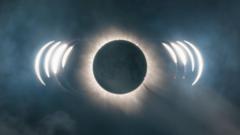
Image source, Josh Dury Image caption, A totality eclipse sequence captured by Somerset astrophotographer Josh Dury
A solar eclipse occurs when the moon moves between the sun and Earth, blocking the sun's light either partially or fully when viewed from the UK.
The National Space Centre said the main event of this year's total solar eclipse (when the moon passes between the sun and Earth, completely blocking the face of the sun) will be visible in a giant arc moving across from Northern Russia to Greenland, Iceland, Spain, and Northern Portugal.
They said although the "arc of totality – the path the eclipse shadow takes - misses us here in the UK, we will still get to see over 90% of the sun covered by the moon."
The next full solar eclipse in the UK isn't expected for another 66 years, on 23 September 2090, according to the Royal Museums Greenwich, so it is definitely worth putting this one in the calendar.
Image source, Bristol Astronomical Society Image caption, On 29 March 2025, a partial eclipse was seen from the Downs, in Clifton, Bristol, with a 34% covering
Holbeche said enthusiasts should scout out a location beforehand using an outstretched hand.
"Looking to the West with your hand outstretched and the thumb and little finger spread as wide a possible, turn your wrist so your thumb touches the horizon (0 degrees) and your little finger is straight above it (using right hand).
"Your pinkie is where the sun will be at the start [around 18:15 ] of the partial solar eclipse. Now, bring your fingers together with your thumb holding down your little finger and rest the bottom of the three remaining fingers on the horizon again.
"The top finger is where the sun will be at the end of the partial solar eclipse," he added.
Image source, Simon Holbeche Image caption, Simon Holbeche said good weather and "a good view all the way to the horizon looking West" are key to seeing the eclipse
The Royal Observatory Greenwich has issued the following guidance for watching the event:
Use eclipse glasses - they will have safety certification 'ISO 12312-2' or 'ISO 12312-2:2015' printed somewhere on the glasses
Use a solar telescope, which are being offered to look through as part of local astronomical society viewing events
Make a pinhole projector which projects an indirect image of the sun onto a surface through a tiny hole
The Royal Observatory Greenwich are live streaming the event which is a safe way of seeing it, they said.
Price said with the right weather, "this will be an amazing astronomical spectacle".
"To view the sun safely, you should use ISO 12312-2 certified eclipse glasses throughout the eclipse. Anything else, including sunglasses, are unsafe.
"If you're using cameras, telescopes or binoculars, all must have proper solar filters fitted to the front of the optics. You must never look at the sun with the naked eye," he added.
Landscape astrophotographer Josh Dury, from Somerset, will be photographing the partial eclipse and said eclipse glasses are vital for anyone trying to capture the event safely.
He recommends placing eclipse glasses over a smartphone camera lens to take a basic image of the eclipse.
For DSLR and mirrorless cameras, he said photographers should use a dedicated solar filter attached to the front of the lens.
For close-up images, a telephoto lens fitted with a solar filter and mounted on a tracking system will produce the best results.
Image source, Josh Dury Image caption, Astrophotographer Josh Dury said eclipse glasses are vital for safe photography during an eclipse
Image source, PA/Stefan Rousseau Image caption, The sun as it is eclipsed by the moon as seen from Torquay on 11 August 1999
Tell us which stories we should cover in Bristol
Contact form Contact form Follow BBC Bristol on Facebook , external , X , external and Instagram , external . Send your story ideas to us on email or via WhatsApp on 0800 313 4630 .
Artemis II crew now halfway to Moon as they take 'spectacular' image of Earth
Six spectacular night sky events to put in your diary this summer
BBC
bbc.com