Bristol Myers Squibb Building Life Science Industry’s Most Advanced AI Factory on NVIDIA Vera Rubin

NVIDIA
July 20, 20264 min read
” That’s two things in one name: pharmaceutical giant Bristol Myers Squibb (BMS) already runs one of the largest AI clusters in life sciences, with serious results to show for it. And they’re doubling down. BMS announced today it is deploying its second NVIDIA DGX SuperPOD , this one built on eight DGX Vera Rubin NVL72 systems — the most powerful and energy-efficient AI cluster in life sciences.
“Instead of equipping a small group of researchers with access to the supercomputer, we’re opening it up to literally every scientist,” says Davis, vice president of research business insights and technology at BMS. ” The eight rack-scale systems, each comprising NVIDIA Vera CPUs and Rubin GPUs, deliver up to 10x the performance per megawatt of the infrastructure it replaces. It will give researchers at the global pharmaceutical giant access to a unified AI platform — including NVIDIA BioNeMo Agent Toolkit for biological AI — for running predictions, training models and powering agentic workflows across the full drug discovery pipeline.
What Davis and other top BMS researchers are really after is what that access makes possible: faster cycles, bigger chemical spaces and a full drug discovery pipeline where researchers think about the science, not the logistics of lining up resources. ” BMS has operated a DGX SuperPOD for about three years, producing meaningful results. AI-enabled target identification already saves scientists weeks of manual work, freeing time to focus on the highest-value scientific decisions.
BMS’s team has used AI to expand its library of CELMoD compounds — molecules engineered to selectively degrade cancer-causing proteins, with applications in blood cancer treatment and beyond. This has opened the door to new targets and new potential medicines across a wider range of diseases. AI is also applied in lead optimization stages of drug discovery using a methodology Sheth calls “Predict First,” which informs experimental gating based on design predictions.
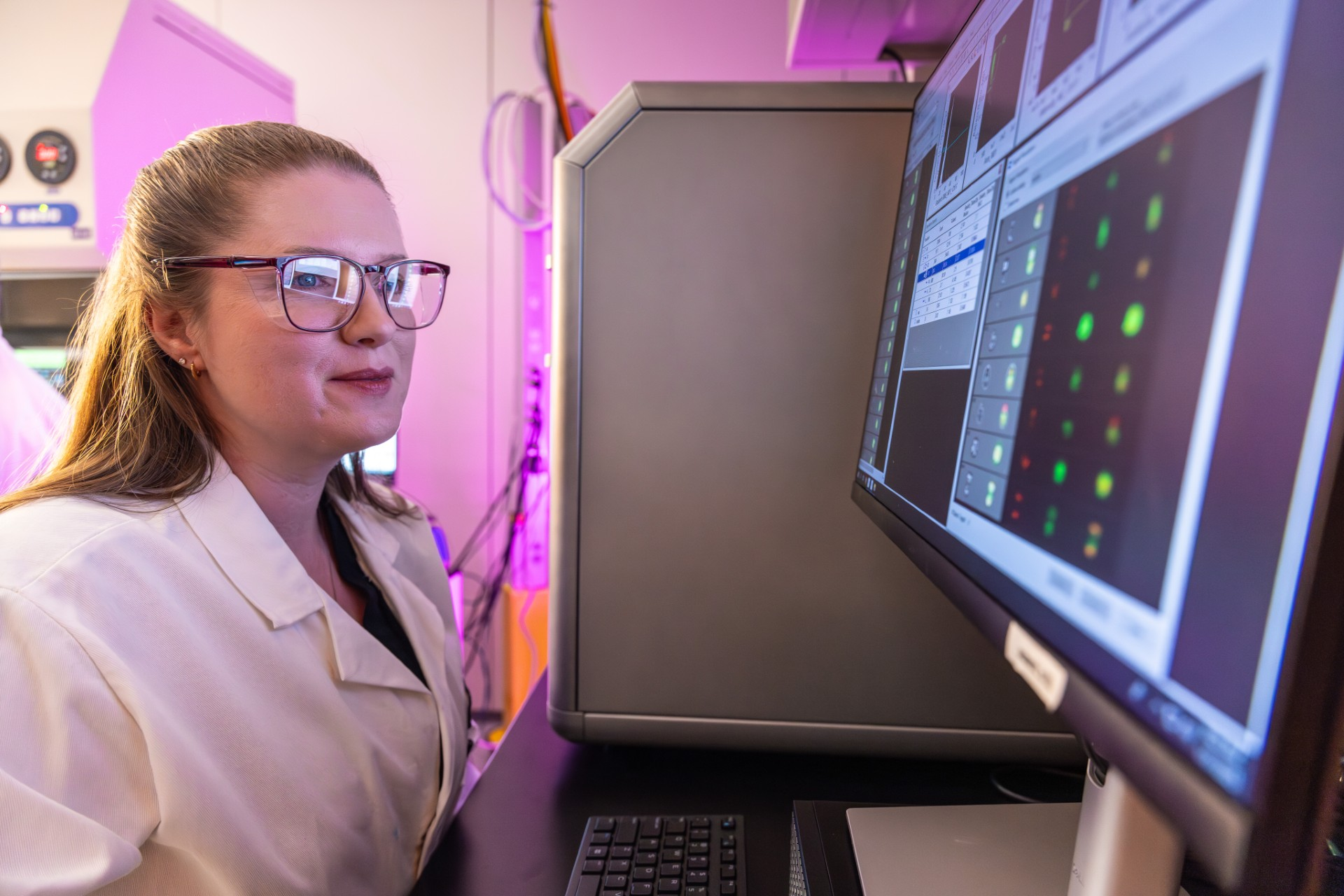
Teams at Bristol Myers Squibb review a computational model of a molecule’s structure, part of the predictive design process that helps scientists anticipate how a molecule will behave in clinic. Image credit: Bristol Myers Squibb “We use predictions as a way to prioritize synthesis of molecules with multi parameter optimization,” she explains, “to weed out molecules that wouldn’t necessarily meet the property landscape we’re working towards. This ensures precious laboratory experiments are aligned with progressing molecules that have the highest probability of success.
“We’re saturated,” Davis says. “We’re in production with some very large-scale predictions around large molecules. ” A computational chemist by training, Davis spent years doing the science before concluding the technology wasn’t keeping up — and that she’d rather go fix it.
