
AI’s most important protocol is getting a little bit easier to use
Under the new system, the protocol will take a looser, "stateless" approach to session IDs on the server side, similar to how most ordinary websites already work.
TechCrunch
Everything about artificial intelligence — new models, research breakthroughs, and how AI is reshaping industries.
132 articles found
Under the new system, the protocol will take a looser, "stateless" approach to session IDs on the server side, similar to how most ordinary websites already work.

The one-year-old startup aims to reinvent financial architecture for autonomous AI transactions.


187 points 137 comments on Hacker News · unslop.run


Adobe's experimental camera app has taken an unexpected turn. After Project Indigo was launched last year to provide a "more natural (SLR-like) look" for iPhone photography, the Indigo camera app is now being updated with a suite of generative AI tools. And the change doesn't rely upon Adobe's own Firefly AI models. Adobe describes the […]
A single AI agent conversation can look flawless scored on its own and still point to a broken product. That gap is driving a shift in how enterprises evaluate agents, away from scoring individual traces and toward comparing cohorts of users against a baseline. At VB Transform 2026 , Harrison Chase, CEO of LangChain; Hui Zhang, CTO and co-founder of Conviva; and Emmanuel Turlay, director of engineering at CoreWeave, described that shift, along with a parallel move toward cheaper, narrower judge models. Agent-as-judge — judging one AI agent's output with another — hasn't replaced LLM-as-judge, which Chase said remains the default. The larger tension, Zhang said, is between automated judging, whether by LLM or agent, and human review. "You have scalable but ungrounded, whether it's agents as judge or LLMs as judge, you grade the outcome, you grade the work. It still is very difficult to ground it and then you use humans and that's just not scalable," Zhang said. "The whole industry is facing this, which poison you want to pick." Evaluation criteria now function as the product spec That gap — a conversation that scores well but still signals a broken product — is what teams try to close by building an exhaustive evaluation suite before they ship anything. Chase said that doesn't work. "We sometimes see teams that have almost eval paralysis," Chase said. "They're like, this is an eval set, I can't launch it. The best teams launch and then iterate." Chase framed evaluation criteria as a living specification, not a one-time test suite: a product requirements document — the standard software-development spec for what an application should do. "Evals are like the new PRD," he said. "They define what your agent should and shouldn't do." Turlay described hitting the same failure from a different angle. "I was trying to reach 100% coverage for my tests, and I still had bugs in production," he said — a test suite that looked complete but still missed what mattered, the same gap Chase was describing with evals. Broad, always-on monitoring, he said, catches more real failures than an exhaustive pre-launch test suite. Teams should set up wide online checks first, use those to identify failure classes as they occur, then build a targeted offline evaluation set around the problems that surface. Why scoring traces one at a time is a mistake Even a well-built evaluation process can still score the wrong thing. Zhang's objection is to how most teams run evaluation: sampling traces, whether 50 of them or a full population, scoring each in isolation. That approach misses a signal that only shows up when comparing cohorts of users against a baseline, a method Zhang calls contrastive analysis. Zhang illustrated it with a retail example: a shopper asks an agent for a running shoe ahead of a half marathon, the agent asks qualifying questions, and the shopper buys a shoe. Scored individually, that interaction looks fine. But the clarification ratio, how many follow-up questions an agent asks before completing a task, came in three times higher than baseline for that shoe category across the full user population. A second metric, how often shoppers finished their purchase outside the conversation, was five times higher than baseline for the same category. Neither number is visible from a single trace. Both point to a debuggable, category-specific problem. Zhang said the industry also lacks a second data source: what happens before, between and after the conversation, not just the trace itself. Sizing the judge to the job Once contrastive analysis flags which category is actually broken, the next problem is what watches for it going forward — and at what cost. Turlay's rule was to start with the most capable model available to prove a task is solvable, then work down. If it can't be done with a top-tier model, he said, it won't work with a smaller one. Once a pattern proves viable, teams can sample a fraction of traffic instead of judging every interaction, and move simpler tasks like binary classification to smaller open source models. LangChain took that further, fine-tuning its own model to detect when a user believes the agent made a mistake, a signal Chase calls perceived error. "The model we fine-tuned was a Qwen model," he said, referring to Alibaba's open source family. Combining hand labeling with distillation, the result performed well. "Same as [Claude]Sonnet, for, depending on how we served it, either 10 to 100x cost reduction," Chase said. Not every guardrail needs a model. Chase pointed to Claude Code's own guardrails as proof: regexes, the common programming technique for finding and validating patterns in code. "A lot of the guardrails they had were just regexes," he said. "They weren't small LLMs, they were just regexes." LLM-as-judge doesn't mean human-in-the-loop disappears The bigger question is whether using LLM as a judge removes the need for a human in the loop. Turlay pointed to accountability, drawing on his prior work at a self-driving car company. His team compressed data intake and retraining into a two-week cycle for shipping a new model to the car. Even then, someone still had to sign off. "I felt confident on behalf of the company to say this model should go into the car," he said. The same logic extends to legal, finance and healthcare. "Before we can remove a human to say, I endorse this and I take responsibility legally for it, it's going to be a while before agents can do that on their own." Zhang agreed a human has to remain the guardian on corner cases, even as automation eventually runs at a scale that beats individual human accuracy — machines can see more at the pattern level. Chase went further: that human check isn't just a safety net. "Human in the loop is really important for building trust in how these agentic systems work, and also really important for memory and learning from systems," he said. "There has to be interactions in order for the system to learn."
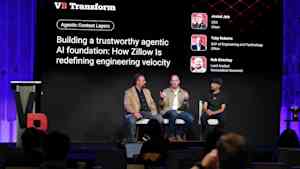
Zillow, the real estate technology company, doesn't get one conversation with its customers. They move from a phone screen to a loan officer to a real estate agent, sometimes over months or years, and expect the context to follow them. A single chatbot could never carry that thread. At VB Transform 2026 , Zillow SVP of Engineering Toby Roberts and Glean co-founder and CEO Arvind Jain described how they built AI architecture meant to carry context across that entire journey — and why context, not raw data, turned out to be the harder problem to solve. Zillow's products touch roughly 80% of U.S. real estate transactions each year, and the company has been using AI long before ChatGPT existed. "We pretty quickly identified that we were going to need a persistent context layer that was going to meet our customers and the professionals wherever they were," Roberts said. Data was never the hard part Roberts said Zillow's AI effort started where most enterprise AI efforts start, with the data itself. "We started with a large push around making sure our data did have the right foundation," Roberts said. That meant a data mesh approach, clear data lineage and a governance structure with permissions and identity attached to the data itself. None of that turned out to be the hard problem. The hard problem was building something that remembered where a customer was in their journey and carried that forward, no matter which surface they showed up on next. "This context layer has to live to be able to support you where you are at any given point in your journey," Roberts said. Zillow chose to own that layer itself rather than depend on a single external chat interface, a decision Roberts said the team reached quickly once it looked at the shape of a real transaction rather than a single conversation. Why Zillow built its own architecture, and where Glean fits into it Zillow built its own harness rather than route customers through a single model API. The team drew on 20 years of machine learning history behind products like Zestimate, leaning into smaller, task-specific fine-tuned models instead of one general-purpose model. Internally, that harness runs alongside Glean. Roberts said Zillow now has thousands of Glean agents in production, handling repetitive tasks with tens of thousands of executions across the company. Glean's pitch, per Jain, is centralizing that integration work once, through the Glean MCP gateway, rather than letting finance, legal and marketing each rebuild their own connections to the same systems. That centralization is also a cost lever. Jain pointed to two mechanisms: model routing, which sends most tasks to smaller, cheaper models instead of defaulting to frontier models, and precomputed context, which avoids an agent burning tokens assembling its own context from scratch. "Claude is also very slow because the first part of assembling that context actually takes forever," Jain said. Routing that request through Glean instead, he said, can cut token consumption by as much as half. What Zillow and Glean's approach means for enterprises Across data, cost and permissions, the session offered a few practical takeaways for enterprises building agentic AI on their own systems. Build the measurement baseline before the AI push, not after. Roberts said Zillow's ability to credibly attribute a 40% increase in shipped code to AI adoption rests on a DORA metrics baseline the team put in place years earlier, not on the AI rollout itself. Centralize context once instead of letting every team rebuild it. Jain's core argument for Glean's platform is that duplicated integration work across finance, legal and marketing teams is a hidden cost most enterprises haven't accounted for. Don't assume permission inheritance is enough for regulated data. Even with a permissions-aware context platform in place, Zillow layered hard rules and a standing compliance check on top for its most sensitive categories, rather than trusting the architecture to handle it automatically. Treat context as a cost lever, not just a capability. Model routing and precomputed context were the two mechanisms Jain pointed to for cutting AI spend, both aimed at reducing wasted token consumption rather than adding new capability. "Models by themselves are not enough to bring automation with AI inside your enterprise," Jain said. "You do have to connect it with your enterprise context."
Hi HN, I’m Alex Southmayd, the founder of Bloomy ( https://bloomylearning.com ) – an AI-powered mastery-learning platform for K-12 students. Bloomy provides students with an AI tutor alongside adaptive curriculum (right now Math, English Language Arts, and Writing). How it works: we diagnose students’ skill gaps, place them on personalized learning paths, and give them standards-aligned lessons and a Socratic AI tutor that scaffolds their learning without just giving away the answer. The goal is to solve the Bloom 2-sigma problem ( https://en.wikipedia.org/wiki/Bloom%27s_2_sigma_problem ) with AI. Short launch video: https://tinyurl.com/bloomylearning Longer product demo: https://youtu.be/XHvoKt6qMeo Families access for Bloomy: https://bloomylearning.com/families I started as a teacher. I taught 7th-grade English and writing with Teach For America, and every day I struggled to deliver differentiated instruction to 30 students with 30 different sets of needs. Some students needed remediation, some needed acceleration, and many needed a tutor sitting next to them helping them reason through the next step. Benjamin Bloom’s two-sigma result—that one-on-one tutoring can produce much better outcomes than conventional classroom instruction—always felt intuitively true to me. The hard part was making that kind of attention affordable and available to every child. Then AI changed the cost curve. When I saw schools such as Alpha organize academics around mastery rather than seat time, the model clicked. If you’ve heard of Alpha School, that is directionally the kind of learning model that inspired us. But I kept thinking about the families and schools that already exist: homeschool families, microschools, hybrid schools, and regular classrooms where most children are today. Most students and teachers see learning gaps at the wrong resolution. They get a grade, percentile, benchmark score, or broad standard—not “this is the next skill this student should learn.” Existing personalized-learning products often feel like digital worksheets: they provide plenty of practice, but not much diagnosis or teaching. Very few have AI tutors providing the core instruction. Bloomy starts with a diagnostic—we integrate with third-party assessments and provide our own—and creates a learning path for each student. Students work one skill at a time, receive a short lesson, practice at an adaptive difficulty, and only move forward after demonstrating at least 90% mastery. The learning path updates as the student works, based on their performance and our knowledge graph of skill prerequisites (built in collaboration with Learning Commons / Chan Zuckerberg Initiative). Each skill has three stages. Base Camp teaches the concept with worked examples. Climb provides guided practice and Socratic support. Summit is an independent ten-question mastery assessment with no hints or AI assistance. Students need to achieve 90% on the Summit to advance. If they struggle too much, they’ll be routed to a different skill better suited for their level. BloomyBot is not a blank chat window but rather a live, interactive, and observant digital tutor. During practice, it receives the active passage or problem, the question, the student’s attempt, an authored explanation, and relevant misconception context. It follows a scaffolded tutoring ladder: first asking what the student tried, then pointing toward the concept, suggesting a strategy, working through one step together, and only providing heavier scaffolding after the student has struggled, adapting to and learning from the student along the way. Students can interrupt it, and we’ve begun to roll out multilingual support for Spanish, French, and a few other more niche languages that customers have asked for. We currently use a variety of Anthropic and OpenAI models for BloomyBot. The tutor is restricted to the current lesson, redirects unrelated questions, limits conversation length, and is unavailable during mastery assessments. The language model does not choose the curriculum or decide whether a student has mastered a skill. That separation is important. A conventionally “helpful” AI response can be a bad tutoring response: if it gives away the answer, the student completes the task but may not learn anything. Our goal is not to build a homework-answering chatbot. It is to put AI inside a structured loop of diagnosis, instruction, practice, feedback, and independent mastery. LLMs can still be wrong, and we do not claim our constraints eliminate that. We reduce the surface area by grounding BloomyBot in authored lesson content, keeping it on topic, logging conversations, and removing it from assessments. Teachers and parents can review tutoring activity, students can report problems, and safety signals trigger human alerts and a backup audit. We also do not see Bloomy as a replacement for teachers, parents, or human tutors. A good human tutor is better. The narrower question we are testing is whether, during a bounded learning session a student would already be doing, a context-aware tutor can provide better help than static “correct/incorrect” feedback. Longer term, the question becomes more whether a student would perform better with one-on-one AI tutoring (at least in certain aspects of the curriculum) than with many-to-one instruction in a medium- or large-sized classroom. Bloomy is now being used across several settings: traditional districts, charter schools, hybrid schools, microschools, homeschools, and families looking for additional academic support. In an early pilot at a charter school in Massachusetts serving ~150 students in grades 6 through 8, students averaged roughly 1.8 times the expected winter-to-spring NWEA MAP growth. This was an observational pilot, not a randomized study, so we treat it as an encouraging signal rather than proof that Bloomy caused the difference. Parents and teachers can see what a student has mastered, what is in progress, and where support may be needed. We have found that adults generally do not want another generic score; they want to know which small number of skills deserve attention this week. Bloomy makes money through family subscriptions and school licensing. ELA costs $39/month or $279/year per learner, and Writing Studio costs $19/month or $139/year. Math is scheduled to launch July 31 at the same price as ELA. Schools and microschools pay per student, with pricing varying by subject coverage, enrollment, rostering, and implementation needs. Because children use Bloomy, we collect learning responses, progress data, and tutoring conversations. We do not sell personal information, use child data for behavioral advertising, or permit model providers to train general-purpose models on identifiable child data sent by Bloomy. We have Zero Data Retention agreements with both Anthropic and OpenAI. Parents and schools can request access, export, correction, or deletion under the applicable account or school agreement. More background on me: after Teach For America, I taught and designed GMAT and GRE curriculum for Manhattan Prep / Kaplan, led the driver acquisition team for Lyft’s New England markets, completed an MBA at Stanford, and led AI transformation projects at McKinsey (so when models finally became good enough this past January to achieve the kinds of things I am pursuing with Bloomy, I was in the right place at the right time to begin building). Bloomy brings together the different parts of my career that I care most about: educational outcomes, learning design, building products, and getting useful technology into people’s hands. I’d especially value feedback from parents, teachers, engineers working on child-facing AI, and people who have built tutoring, assessment, or adaptive-learning systems. Does the separation between guided AI help and independent mastery make sense? Where do you see the greatest potential with AI in education? Where are our safeguards insufficient? What evidence or product behavior would you need to trust something like this with a student? Certainly there are many dangers and pitfalls we must beware of, too, but I believe we can really move the needle in K-12 (for the first time in a long time) if we use AI responsibly and intelligently.
The enterprise technology ecosystem is caught in a costly cycle. Over the past two years, millions of dollars have been funneled into generative AI pilots, yet many of these initiatives stall out before ever reaching a live production environment. When a project fails, the immediate instinct of technical leadership is often to blame the model: The context window was too restrictive, the latency was too high, or the reasoning capabilities simply were not there. But as data engineers building the scaffolding for these systems, we often see a different reality: The model receives the blame, but the pipeline usually contains the root cause. Production gen AI rarely fails because of model limitations alone. More often, it fails because the enterprise data foundation underneath it is fundamentally unready. This is what I call the 'Cleanup Trap': The false belief that an organization can pipe fragmented, inconsistent, and ungoverned legacy data into a large language model (LLM) orchestrator and simply “clean it up” or patch it at the retrieval layer. The mirage of the retrieval layer In a standard retrieval-augmented generation (RAG) architecture, the retrieval layer is tasked with pulling relevant business context to ground the model’s responses. Because modern frameworks make it simple to stand up a vector database and a basic embedding pipeline, leadership often assumes that the data engineering problem is solved. It is not. When an embedding model receives raw, unvalidated data directly from operational silos, the resulting vector space inherits the structural noise, duplicate records, and conflicting states present in the source systems. If the core data pipeline suffers from silent degradation — schema drift, missing fields, delayed change-data-capture (CDC) synchronization — that degradation cascades directly into the vector store. An AI model cannot accurately synthesize customer intelligence if the data pipeline behind it is serving stale, contradictory profiles across disparate storage layers. No amount of prompt engineering, semantic reranking, or vector hyperparameter tuning can compensate for a broken ingestion pipeline. If the foundation is compromised, the downstream application will hallucinate, expose unauthorized context, or fail to deliver deterministic value. Shifting from ad-hoc patching to programmatic guardrails To break out of the 'Cleanup Trap,' enterprise data teams must stop treating data quality as a post-processing step. They need to treat data readiness for AI with the same rigor they bring to traditional transaction processing. This requires a deliberate architectural shift toward zero-trust data ingestion, structured validation frameworks, and automated anomaly detection before data ever reaches an AI orchestration layer. 1. Harden the ingestion pipeline Data quality checks cannot exist as a nightly batch afterthought. If an enterprise AI application relies on real-time data to assist users, validation must happen inline. Teams should implement explicit schema validation checks at the earliest ingestion point, such as the streaming ingress layer or the bronze landing layer of a medallion architecture. If an upstream operational database mutates a schema without warning, the pipeline should quarantine anomalous payloads rather than allowing corrupted metadata to pollute downstream AI contexts. 2. Use multi-tiered algorithmic validation Static row-count validation rules are insufficient for AI readiness. True data health requires a multi-tiered approach. This means pairing structural verification — null checks, type conformance, and schema validation — with statistical profiling to monitor for data drift. Tracking metric deviations across feature distributions helps ensure that historical context remains stable over time. If a pipeline suddenly processes an unexpected spike in empty string variables or structurally deviant fields, automated alerts should trigger an immediate pause before vector database updates continue. 3. Decouple security and compliancemfrom the model An LLM should never be the arbiter of data access control. Trying to enforce row-level security or personal data filtering through system prompts is a compliance risk. Security must be managed within the data infrastructure tier. Enterprise data foundations should enforce strict access controls, tokenization of sensitive identifiers, and rigorous lineage tracing before information is indexed into vector stores or passed into an agent’s context window. Technical alignment: A pragmatic blueprint For technology leaders mapping their infrastructure roadmaps, AI readiness requires evaluating data pipelines against a strict operational checklist. Can you trace a flawed AI response back to the exact pipeline execution, source record, and transformation step that produced it? Does your data lake architecture have a programmatic mechanism to segment and quarantine corrupted or non-compliant data before it reaches production feature stores? Are your operational systems and AI-facing vector databases tightly synchronized, or are your agents making automated decisions based on outdated snapshots? These questions matter because production AI is not just a model deployment problem. It is a data reliability problem. Building for the production era The honeymoon phase of gen AI experimentation is ending. Enterprise leaders are demanding measurable, predictable, and secure business outcomes from their AI investments. If an organization wants to transition from isolated, impressive-looking demos to resilient, production-grade AI systems, it must redirect its focus. Stop looking exclusively at the model tier. The real competitive differentiator is not only the LLM an organization chooses. It is the engineering discipline, data governance, and pipeline resilience of the infrastructure built to feed it. In the production era of AI, data engineering is no longer a backend function. It is the control plane for enterprise intelligence. Naveen Ayalla is a senior data engineer.
 ML Development in VS Code with Google Cloud Power: Workbench Extension Now AvailableGoogle DevelopersJuly 21, 2026
 Building scalable AI agents with modular prompt transpilationGoogle DevelopersJuly 21, 2026
 LiteRT.js, Google's high performance Web AI InferenceGoogle DevelopersJuly 21, 2026
 Bridging the Domain Gap: AI Race Coach built with Antigravity and GeminiGoogle DevelopersJuly 21, 2026Tesla cash burn to test investor faith in AI betsHacker NewsJuly 21, 2026