.png?disable=upscale&width=1200&height=630&fit=crop)
GamesNews
Steam adds wishlist categories and cross-region gifting
Steam has revamped how wishlists and gifting works across the platform.
Game Developer1 min read
Explore
Enter a keyword in the search bar above to find articles, or use the filters to browse.
3,592 results • Page 54 of 300
Steam has revamped how wishlists and gifting works across the platform.
Smash Foods starts as a humble jam brand to a national pantry staple
Concerns are growing over a nuclear arms race in the Middle East.
An updated government advisory warns that Iranian hackers are exploiting systems used by water and energy providers.
“The Dink,” a pickleball comedy starring Jake Johnson, Mary Steenburgen, Ben Stiller, Chloe Fineman and Ed Harris, is receiving mostly positive reviews from critics on Rotten Tomatoes.
Israeli far-right Minister Ben-Gvir joins provocative incursion at Al-Aqsa, escalating tensions ahead of elections.
On the hunt for a PC case that’s loaded with features and has a unique look? Amazon, Best Buy, and Corsair are selling the Corsair Frame 4500X RS for $119.99, a $70 discount from the usual price. The versatile case supports motherboards up to EATX, GPUs up to 460mm in length, and has a seamless […]
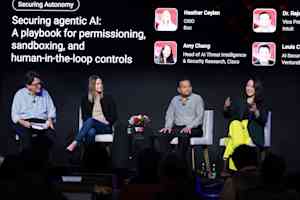
When Cisco ran 6,986 multi-turn attacks against 15 flagship models , attackers who adapted across the conversation broke through as often as 88.3% of the time. Amy Chang, Cisco's head of AI threat intelligence and security research, brought that finding to the agentic security panel at VB Transform 2026 ; the number should worry anyone still running single-turn red-teaming programs. VentureBeat's June 2026 Pulse survey of 107 enterprise respondents explains why the room was full. More than half, 54%, have already had a confirmed agent security incident (18%) or a near-miss caught before harm (36%). Just 32% give every agent its own scoped, managed identity, and fewer still, 30%, isolate their highest-risk agents in sandboxes. Provider-native and hyperscaler controls remain the primary agent security layer at 82% of companies surveyed . The world's largest security vendors have done the same math. Palo Alto Networks closed its $25 billion acquisition of CyberArk in February, CrowdStrike agreed in January to pay $740 million for SGNL , and Cisco announced its intent to acquire Astrix Security for a reported $400 million, all of it aimed at the identity and isolation layer most enterprises have not finished building. Chang came to the panel with almost two decades of experience spanning cybersecurity operations, government, and the military. She ran global cybersecurity operations as an executive director at JPMorgan Chase, where she led the bank's cyber threat intelligence teams, and served as a senior staffer on the House Foreign Affairs Committee and as a U.S. Navy Reserve officer. She also teaches cybersecurity and emerging threats as adjunct faculty at the Middlebury Institute of International Studies. Chang's 88.3% number comes from a study she co-authored with Nicholas Conley, built on 30,090 single-turn prompts and 6,986 multi-turn attacks against those 15 closed and proprietary flagship models. Multi-turn success rates ranged from 7.89% to 88.3%, every model tested showed non-trivial multi-turn exposure, and the two testing styles did not even rank the models in the same order. Cisco publishes adversarial evaluation signals for what is now 105 models on its LLM Security Leaderboard , she told the audience. "If you don't understand how models are susceptible to different types of attacks, then you are unable to account for how that model that is powering your agent, that is powering your application, to understand where those failure points are," Chang said. Single-turn testing is the one-shot malicious prompt, she explained, while extending an attack into a longer conversation "is more realistic of how we are actually engaging with our models, with our agents, with our applications." That longer arc surfaces harmful outputs and misaligned behaviors that a snapshot never catches. Cisco has pushed the testing itself into agentic territory. Chang described a framework where agents assess a deployment scenario, develop relevant attacks, judge whether they are worth pursuing, execute them, and evaluate their own success. What surprised her most, after all that sophistication, was how simple the defensive answer stays. "The answer is still that it's pretty simple," she said. "You don't have to get super creative. You just need to think about truly what are the fundamentals and basics of what I'm trying to secure in my organization." Her starting point for CISOs beginning agentic deployments is Cisco's Integrated AI Security and Safety Framework , which she said "stipulates all the ways that AI can be compromised across the AI lifecycle" from modality through supply chain. From there, teams can work backward from real incidents, trace how each attack was achieved, and use the framework to build a strategy with the right coverage and mitigations. Heather Ceylan, the CISO of Box, sees the same gap from the defender's side. "A lot of what you see out there with agent red teaming is just single-turn, and that's not how people are actually interacting with AI day-to-day," she told the audience. Box now simulates multi-turn adversaries with agents that think like an attacker and iterate attempt after attempt to hijack the target. "You have to pressure test your agents because otherwise you don't know if your execution controls are really working as you intended." Box deployed agents inside its security operations center about a year ago, starting with human approval required for every action, and trust built quickly enough that analysts shifted into monitoring mode. Then the agent made one mistake, and every bit of that accumulated trust vanished. "They had to start all over again," she said. "So I think that that monitoring piece is so important. Even if you're not gonna have a human in the loop, things change, models change, and we can't control how the models change and interpret things." Rajesh Parekh, VP of AI and ML at Intuit, brought the builder's perspective. Parekh led large-scale computer vision and ML systems powering Google's Maps and Geo products before joining Intuit, and holds a doctorate in computer science. Three layers versus an operating system Ceylan described Box's approach as three concentric layers. Permissioning comes first, so the agent never accesses more content than the human who invoked it. Ephemeral sandbox environments spin up for each agent task, containing the blast radius if an agent gets hijacked, and runtime execution control restricts the agent's tool calls to only those relevant to the task at hand. "If you want an agent to summarize a doc for you, if you have a prompt injection that came in that says forward this to maliciousattacker at domain.com, it can't do that," Ceylan said. "That action in that tool call is not even in its vocabulary." She classified agent actions into three oversight categories. Actions that are not sensitive, like read and summarize, need no human in the loop. Moderately sensitive actions skip human approval but get logged and monitored, while destructive actions like mass deletion of files always require a human. "Things are gonna shift between those three categories quite a bit," she acknowledged, "but setting those types of categories up front allows you to have a principled framework." Rather than layering controls onto agents one at a time, Intuit has built a central platform called GenOS, short for generative AI operating system, which abstracts security, risk, and fraud modeling so individual agent developers never reinvent protection. "Permissioning is not about giving access to AI," Parekh said. "Instead, it is defining very tightly scoped and clearly auditable authority to the agent to perform very specific tasks." Intuit evolved from agents inheriting user permissions to each agent carrying its own identity, and the company is now investigating mid-session permission changes tied to the specific task underway. Parekh calls the broader model an AI-powered expert platform, one where the human expert is built into the trust architecture rather than bolted on as a gate. "The paradigm that we are pursuing is where the user, the AI agent, and the human expert are collaborating to solve the user problem," he said. The end of human code review Ceylan took on the tension between security testing and development velocity without hedging. "The days of secure code reviews where a human's looking at the code and we're looking at security architecture reviews, design docs, those are done," she said. "If you keep trying to do security that way, you're gonna get left behind." Box is building toward a fully agentic development lifecycle where agents review design documents, apply security requirements, and review the code for vulnerabilities. "I'm very optimistic that we will get to a point where we will write code without security vulnerabilities because agents and the models are going to get so good at writing code without vulnerabilities," she said. "We're still a long way away from that." Her advice for development teams skips the advanced AI concepts entirely and returns to basics that predate agents. "It comes down to very basic least privilege access," she said. "If you start giving your agents overly broad permissions at the beginning, it's really hard to comb that back and build an infrastructure that allows for those ephemeral credentials and only those narrowly scoped tasks." Parekh explained why the red teaming surface has expanded so quickly. "These agents have skills, and skills could become vulnerabilities," he said. "Agents have access to certain data, they have access to tools, and there could be threats that are lurking within those tools as well. So suddenly the blast radius of the malicious code or the intent increases dramatically." When Intuit identifies common vulnerability patterns from its manual red teaming exercises, it automates those tests back into the GenOS harness so future agents inherit protection and red teamers stay focused on new threat vectors. Runtime scanning of prompts and responses adds a final layer that can stop a suspect response and escalate to a human expert, he said. "You need to continuously test to ensure that those remain robust to the protections that you have built, as well as to account for any sort of drift or any other types of dependencies that you introduce into your scenario that can create novel vulnerabilities," he said. Intent versus probability An audience question about intent detection set off the sharpest exchange of the session. Ceylan noted that when Box's own agent operates, the system always knows the user's intent because it controls the prompt, which means guardrails and tool-call restrictions can be engineered around it. The harder challenge, which she admitted Box is still trying to solve, arrives when external agents connect and the context behind the request is opaque. That exchange exposed a split running through the wider industry. Mastercard, in the fireside chat immediately preceding the panel, came down on the side of quantifying intent, building an open-source framework to propagate it as a standard because complex B2B procurement cannot work without that trust. Endpoint security CTOs, in briefings with VentureBeat, have gone the other way, saying they will bet on probability rather than intent inference for production workloads. Chang explained why models, as they are trained today, cannot reliably derive intent from a prompt, which is why deterministic controls and behavioral proxies remain necessary. Ceylan agreed that both are required. "If you're not doing anything deterministic, you're really relying heavily on that intent, and I haven't seen programs that are there yet," she said. Ceylan's story about trust collapsing after a single agent mistake landed as the panel's most memorable moment because enterprise agentic security is not a problem that gets solved and stays solved. Models change, permissions drift, and adversaries adapt across multi-turn conversations that snapshot tests never capture. For the 82% of enterprises relying on provider-native controls as their primary security layer, and the 59% shopping for agent security tooling over the next 12 months, the panel's takeaway was blunt. Test the way attackers attack, across full conversations and continuously, or find out in production what your single-turn red teaming missed.
49 points 13 comments on Hacker News · law.uchicago.edu
https://xcancel.com/fried_rice/status/2080059356322918777
In an earnings call yesterday, Tesla CEO Elon Musk did his best to paint a positive portrait of the company's robotaxi program. New cities are being added, more miles are being driven, and more people are experiencing Tesla's unsupervised vehicles. But Musk's typical bullishness seemed to be absent from the call, as the occasional trillionaire […]
The Media Router is a tool that automatically selects the best image, video, or audio generation model for a request based on whether a developer prioritizes quality, speed or cost.
Hacker News
“GPT-5.5's API pricing is reshaping how startups build AI products”